

API-first has become the de facto standard, it’s crucial to pair it with ‘right integration’ of your core business processes. Think of your business as a sturdy ship, APIs as the ever-changing seas, and integration as your navigation system. You need all three working in harmony to sail smoothly and avoid capsizing in the dynamic waters of the digital economy.
The Continuous Change Challenge: “Dance Like Nobody’s Watching, Integrate Like Everything’s Changing“
While we’ll use FinTech as our primary example, these principles apply broadly to startups in tech sector. Here are the primary areas where continuous adaptation is crucial:
1. Regulatory Landscape:
Challenge: Regulations in finance, healthcare, and other sectors are constantly changing. For FinTech startups, this might mean adapting to new open banking standards, data privacy laws, or reporting requirements.
Strategy:
– Implement a modular compliance framework that can be easily updated.
– Set up automated regulatory tracking systems to stay ahead of changes.
– Build flexibility into your data models to accommodate new reporting requirements.
2. Partner Addition and Removal:
Challenge: Continuously adding/removing partners, for FinTech financial institutions, payment providers, validation API providers, and other partners requires quick API integration.
Strategy:
– Ensure you can onboard APIs quickly by just importing the specification and invoking the operations.
– Support different formats, visual data mapping, and an abstraction layer for your core process.
3. API Changes of Existing Partners:
Challenge: Partners frequently update their APIs, adding new features or deprecating old ones.
Strategy:
– Design your integrations with abstraction layers to isolate changes.
– Implement automated testing for all integrations to quickly catch breaking changes.
– Maintain close relationships with API providers to get early warnings of upcoming changes.
4. Evolving Market Demands:
Challenge: Customer needs and market trends shift rapidly, requiring quick pivots in product offerings and integrations.
Strategy:
– Adopt a microservices architecture for agility in adding or modifying features.
– Use feature flags to gradually roll out new integrations or capabilities.
– Regularly gather and analyze user feedback to anticipate needed changes.
A few more areas to consider like Customer Engagement Channels ,Security and Privacy Updates, Device and AI Adoption etc.
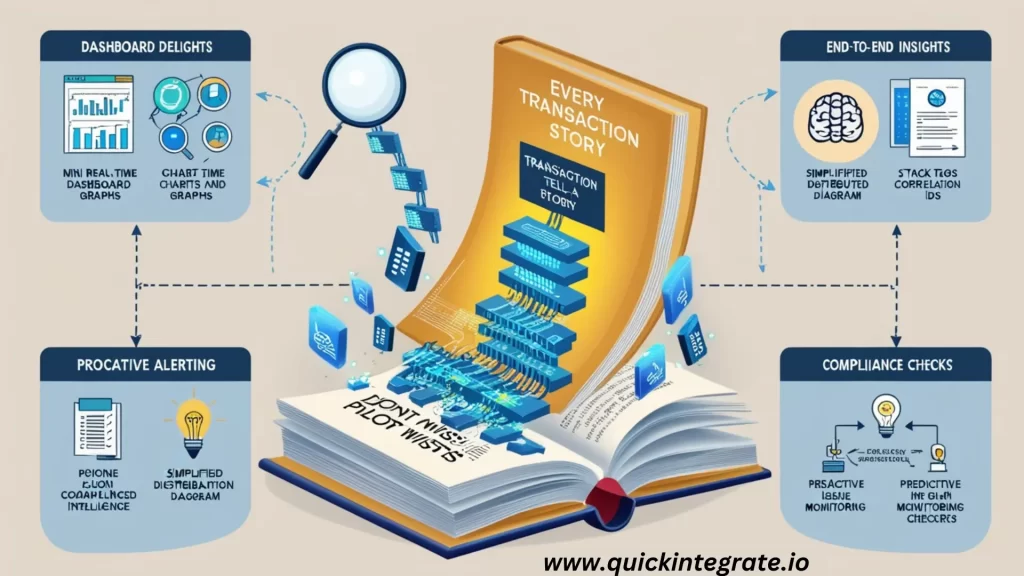
“EVERY TRANSACTION TELLS A STORY,” so ensure it’s visible to make sure you’re not missing the plot twists!
1. Dashboard Delights:
– Set up real-time dashboards. They should be clear, not just pretty.
– Use anomaly detection for transaction volumes and patterns, error rates and types, response times and system performance, and unusual activity that might indicate fraud or system issues. It’s like having a really observant friend watching your back.
– Use log aggregation tools to centralize monitoring across different systems and APIs.
2. End-to-End Insights:
– Implement distributed tracing. It’s like having a map for your data’s journey.
– Use correlation IDs. Think of them as name tags for your transactions at a busy party.
– Set up visual transaction flow maps to easily identify bottlenecks or failures.
3. Proactive Alerting:
– Set up intelligent alerting systems that can distinguish between normal fluctuations and real issues.
– Have clear escalation protocols. Know who to call when things go sideways.
– Implement predictive monitoring to anticipate issues before they occur. Catching issues early can save countless hours and maintain customer trust.
4. Compliance Checks:
– Automate compliance checks. It’s like having a very diligent personal assistant.
– Keep detailed audit trails. Because sometimes you need to show your work.
– Use AI-powered tools to scan for potential compliance issues in real-time.
Conclusion: Thriving in the Age of Continuous Change
In today’s dynamic business environment, the ability to adapt quickly and effectively is more than just a competitive advantage—it’s a necessity for survival. By implementing robust integration strategies and comprehensive monitoring systems, startups can turn the challenge of continuous change into an opportunity for ongoing improvement and innovation.
Whether you’re in FinTech, HealthTech, or any other tech sector, remember, the goal isn’t to eliminate change—that’s impossible. Instead, the aim is to have systems and processes that thrive on change, allowing your startup to pivot quickly, scale efficiently, and stay ahead of the competition.
On technology side ensrue to embrace Embrace modular architecture ,Prioritize API management & integration , Leverage containerization and orchestration, Choose flexible open-source technologies, ensure flexible Deployment Options, avoid lock-ins of anykind, ensure Service Tracking & Observability are built-in and not applied on top, Test Automation is key, Audit/logs should be out-of-the-box , Design for data portability ,Implement robust security measures 🙂