
As a technology startup founder, I’ve often found myself explaining complex technology concepts to business leaders. Let’s break down INTEGRATIONs, APIs, and iPaaS in a way that’s both informative and easy to understand.
Understanding Integrations & APIs: A Real-World Analogy
Imagine your business as a bustling city. Each department – finance, operations, healthcare, traffic, and law enforcement – is like a distinct neighborhood. Integration is the network of highways and bridges connecting these neighborhoods, ensuring smooth and efficient communication. APIs are the traffic signals and road signs that guide the flow of data between these departments.
Business Use Cases: Where Integrations & APIs Shine
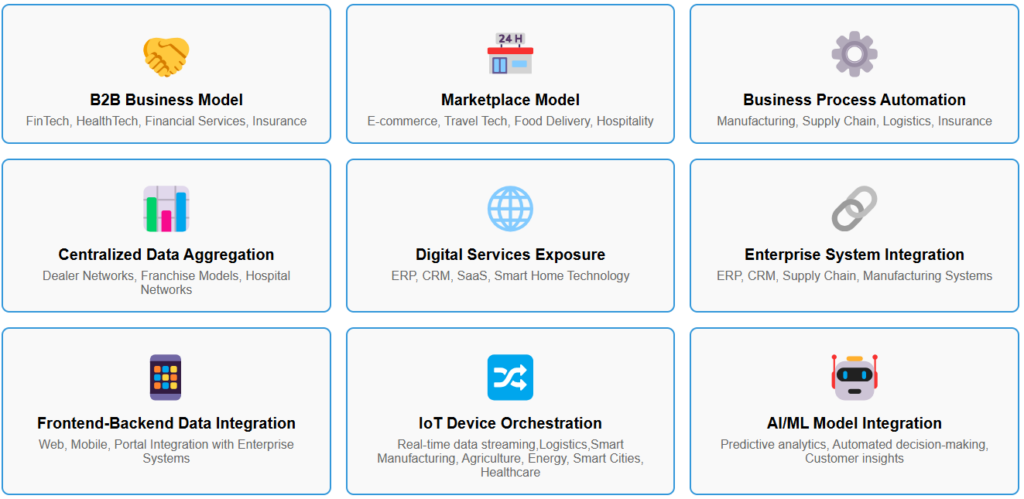
B2B Business Model (e.g., FinTech, HealthTech, Financial Services, Insurance, Lending Platforms)
Marketplace Model (e.g., E-commerce, Travel Tech, Food Delivery, Hospitality, Agricultural Marketplaces, Healthcare Services)
Complex Business Process Automation (e.g., Manufacturing, Supply Chain, Logistics, Insurance, Healthcare, Retail, Automotive, Pharmaceutical)
Centralized Data Aggregation (e.g., Dealer Networks, Franchise Models, Hospital Networks, Trucking and Logistics Companies, Retail Chains, Energy Sector, Telecommunications)
Exposing Business Services/Digital Services (e.g., Core Products (ERP, CRM) as business services, Smart Home Technology Providers, Educational Platforms, SaaS)
Core System Integration/Enterprise Integration (e.g., Enterprise Software (ERP, CRM), Supply Chain Management, Manufacturing, Healthcare Information Systems, Government Services)
Data Integration between frontend application Web, Mobile, Portals and Enterprise Internal Systems
IoT (Internet of Things) Device Orchestration (Industrial Machine Integration ,Smart Manufacturing, Agriculture, Energy, Smart Cities, Healthcare )
Multi-Cloud Ecosystem Integration (Cloud Services, Technology, Financial Services, Healthcare)
Blockchain-Based Decentralized Integration (Finance, Supply Chain, Healthcare, Real Estate, Government)
AI and Machine Learning Model Integration (E-commerce, Finance, Healthcare, Marketing, Customer Service)
Event-Driven Integration Microservices Architecture (Banking, E-commerce, Telecommunications, Gaming)
Edge Computing Integration (Telecommunications, Manufacturing, Automotive, Healthcare, Retail)
Semantic Web and Knowledge Graph Integration (Research, Education, Healthcare, Government, Media)
Regulatory Compliance and Governance Integration (Finance, Healthcare, Government, Legal, Insurance)
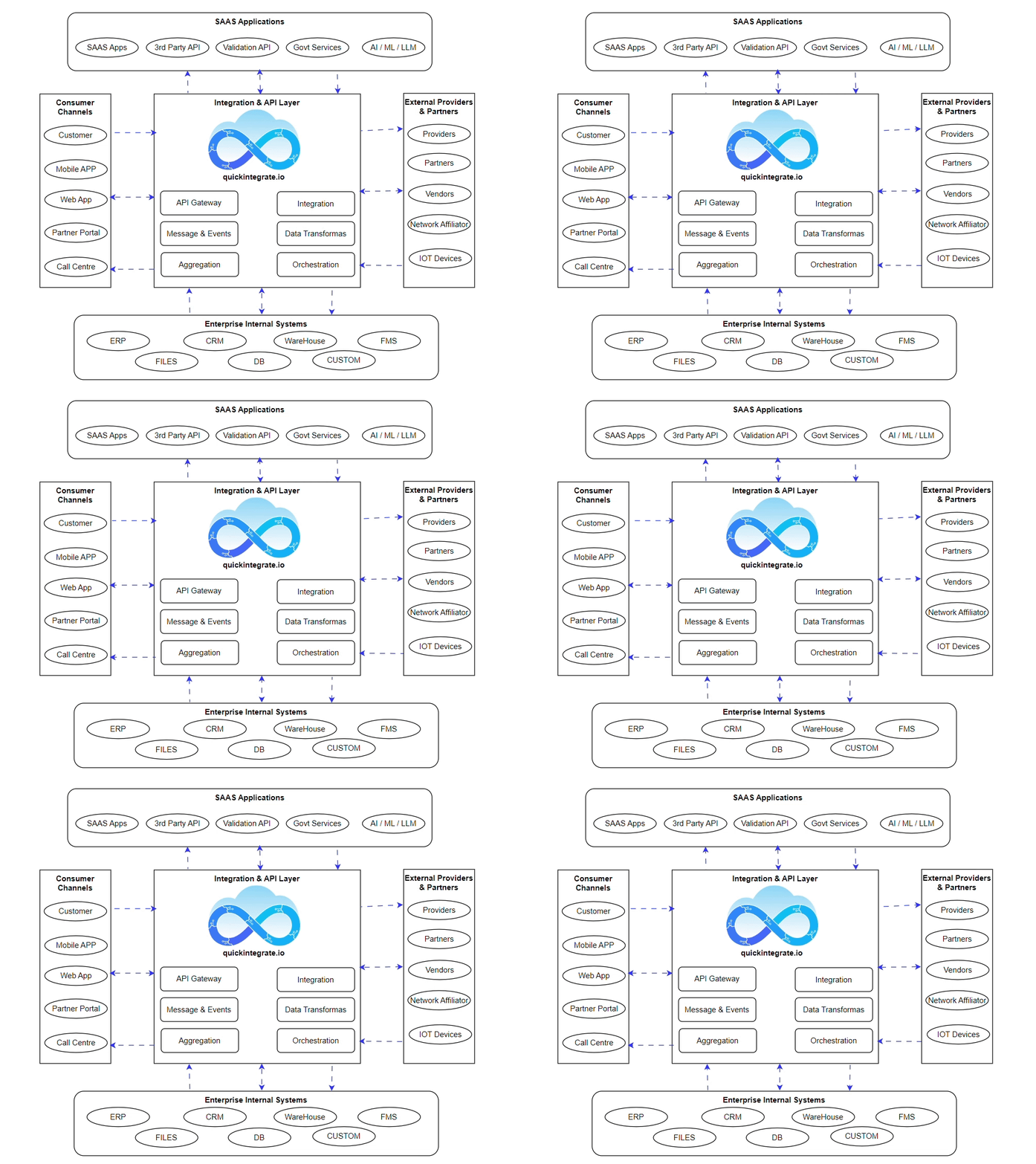
Following are the challenges faced by modern businesses where defined integration and api’s can bring the difference.
##Data Silos:
Different departments and systems within a company often operate with their own data repositories, leading to fragmented information and limited visibility across the organization.
##Slow and Inefficient Processes:
Manual data entry, redundant tasks, and slow communication between departments can significantly hinder business efficiency and productivity.
##Poor Customer Experience:
Inconsistent experiences across channels (e.g., website, mobile app, call center) and slow response times can frustrate customers.
##Difficulty Scaling and Adapting:
As businesses grow and evolve, their technology needs change. Rigid systems and inflexible integrations can hinder growth and make it difficult to adapt to new technologies and market demands.
##Increased Competition:
In today’s competitive landscape, businesses need to be agile, innovative, and customer-centric to thrive.
## Security and Compliance:
Ensuring data security and compliance with regulations (e.g., GDPR, CCPA) is crucial for businesses.
## Difficulty Innovating:
Legacy systems and complex IT infrastructures can hinder innovation and slow down the development of new products and services.
## Lack of Agility and Adaptability:
Businesses today operate in dynamic environments with rapidly changing customer demands, market trends, and technological advancements.
## Difficulty Innovating and Creating New Revenue Streams:
Many businesses struggle to innovate and create new revenue streams due to limitations imposed by existing systems and technologies.
## Increased Regulatory Compliance Requirements:
Businesses face an increasing number of regulations and compliance requirements, such as GDPR, CCPA, and industry-specific standards.
## Rising Costs and Operational Inefficiencies:
Manual processes, redundant data entry, and inefficient workflows can significantly increase operational costs and reduce profitability.
## Difficulty Maintaining a Competitive Edge:
In today’s hyper-competitive market, businesses must constantly differentiate themselves to stay ahead of the curve.
## Lack of Visibility and Control:
In complex and distributed environments, it can be difficult to maintain visibility and control over data flows and system interactions.
The Common Denominator: Continuous Data Flow
All these scenarios involve the continuous movement of data between people, process, applications, machines. Integrations and APIs make this data exchange seamless and automated, leading to improved efficiency, streamlined processes, and better decision-making.
In today’s connected world, integration is no longer a luxury but a necessity. The digital landscape is evolving rapidly. The question is no longer “Do we need integration?” but “How quickly can we integrate to stay competitive